What Are Humans Worth Now?
For a very long time, intelligence has helped humans explain why we are special. That explanation is starting to get uncomfortable.
Something shifted for me this week.
On September 29, the White House brought together leaders from OpenAI, Anthropic, Meta, Google, Nvidia, and xAI to talk about AI safety. They signed a voluntary accord on safety controls and audits for the most capable models. The same day, President Trump signed an executive order directing the federal executive branch to use “Super Intelligence” and “SI” in place of “Artificial Intelligence” and “AI” in official communications, websites, reports, and policy documents. The order changes the name first and asks for the definition later: the President’s science and technology adviser has 60 days to propose a legal one. The terminology is political, not scientific. But the larger point is hard to ignore: intelligence outside the human mind is now consequential enough to be discussed as infrastructure, policy, and national strategy.
Also on September 29, OpenAI’s DevDay made the other side of that shift visible. The company introduced Dots, agents designed to remain active over time and pursue goals across applications, and added computer use to its Agents API, which already offered hosted execution and tools. None of those capabilities, taken individually, is a philosophical event. Put together, they describe a practical one.
Intelligence is becoming something we can build outside ourselves, deploy, price, give permissions to, and connect to the rest of the world.
That is a strange development for a species that named itself Homo sapiens, the human who knows. Linnaeus defined us with a command: know thyself.
For much of our history, intelligence has sat near the center of the story we tell about ourselves. Whenever another animal complicated that story, we moved the boundary.
Tool use was supposed to separate us. Then we found animals using tools. Memory, cooperation, planning, communication, and culture turned out to exist, in some form, in other animals too.
So the line moved upward.
Language. Reason. Mathematics. Science. Civilization.
There was always another hill to stand on.
AI makes that strategy harder because it is entering directly into the systems we built around cognition itself. It writes software, produces images, searches, plans, operates tools, and participates in scientific work. Increasingly, it can continue acting beyond a single exchange.
None of this makes a machine human. As far as we know, these systems do not experience hunger, shame, desire, grief, tenderness, fear, or love. They do not grow up inside families or carry childhood memories in the way we do. They do not appear to know that they will die.
Those differences may turn out to be enormous. But intelligence itself is becoming a weaker place to draw the boundary.
I had been thinking about all of this mostly as an intellectual problem until I walked into Museo Tamayo in Mexico City. I’m here this month, mainly for Design Week Mexico and Mexico Tech Week, spending a lot of time thinking about artificial intelligence, technology, design, and what all of this is becoming.
Inside the museum, in the exhibition Tamayo, Nieto, Toledo: The Paris Years, the question suddenly felt less abstract.
One of the first works that stopped me was by Rodolfo Nieto, from his Zoología mental series. It is dense and unstable. Color piles on top of color. Organic forms appear and disappear. The composition seems to be constantly becoming something without ever quite arriving. It feels alive.
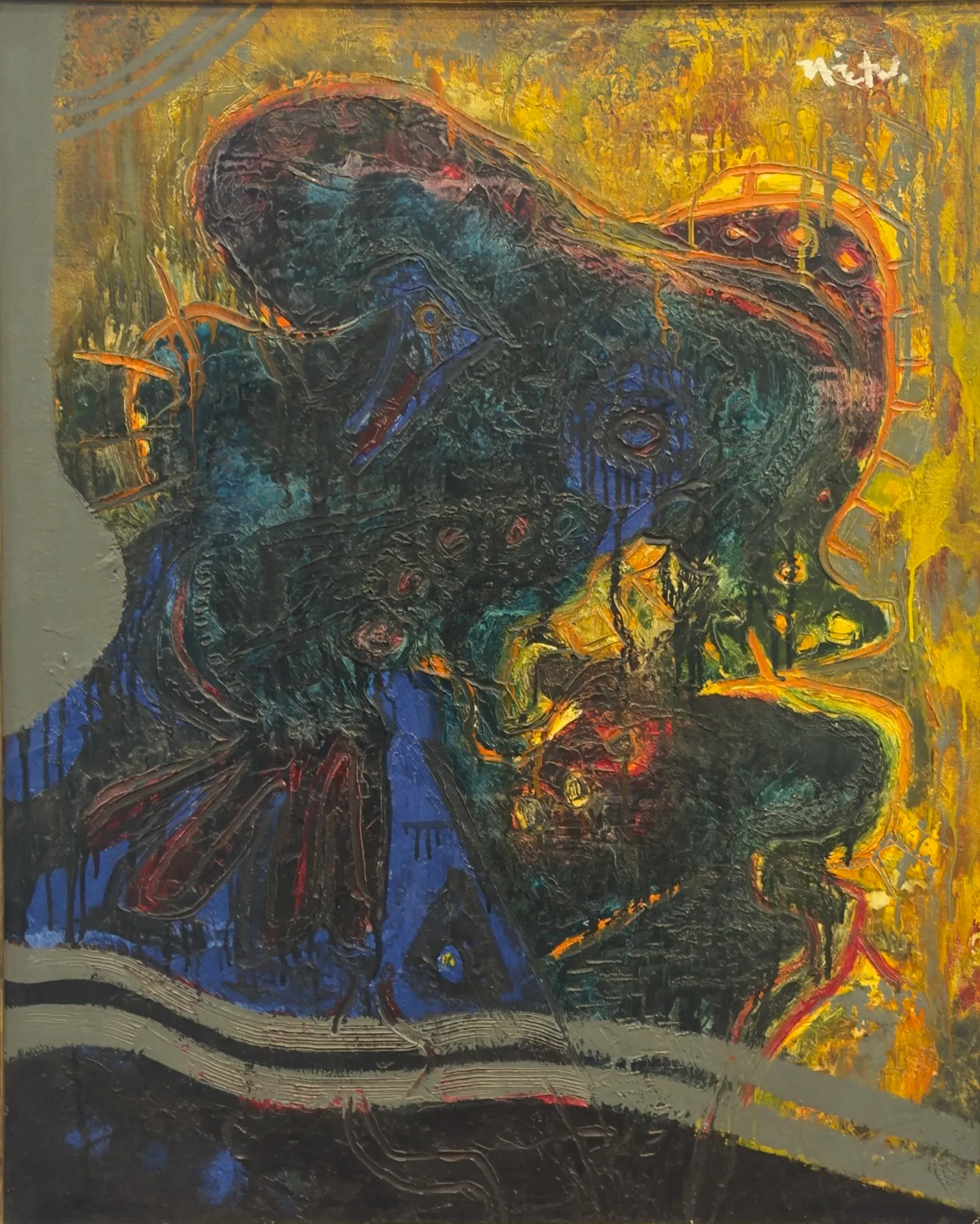
Rodolfo Nieto, Sin título (Untitled), 1964. Zoología mental series. Enamel on canvas. Corona Bähre Family Collection.
Another Nieto, Noche transfigurada (1966), does almost the opposite. Dots, lines, and forms sit inside a much darker field. The color seems absorbed by the darkness. I found it painful.
Then there is Tamayo. In Juego de niños, much of the image appears buried beneath gray. It feels almost as if he finished the painting and then covered part of it in fog.
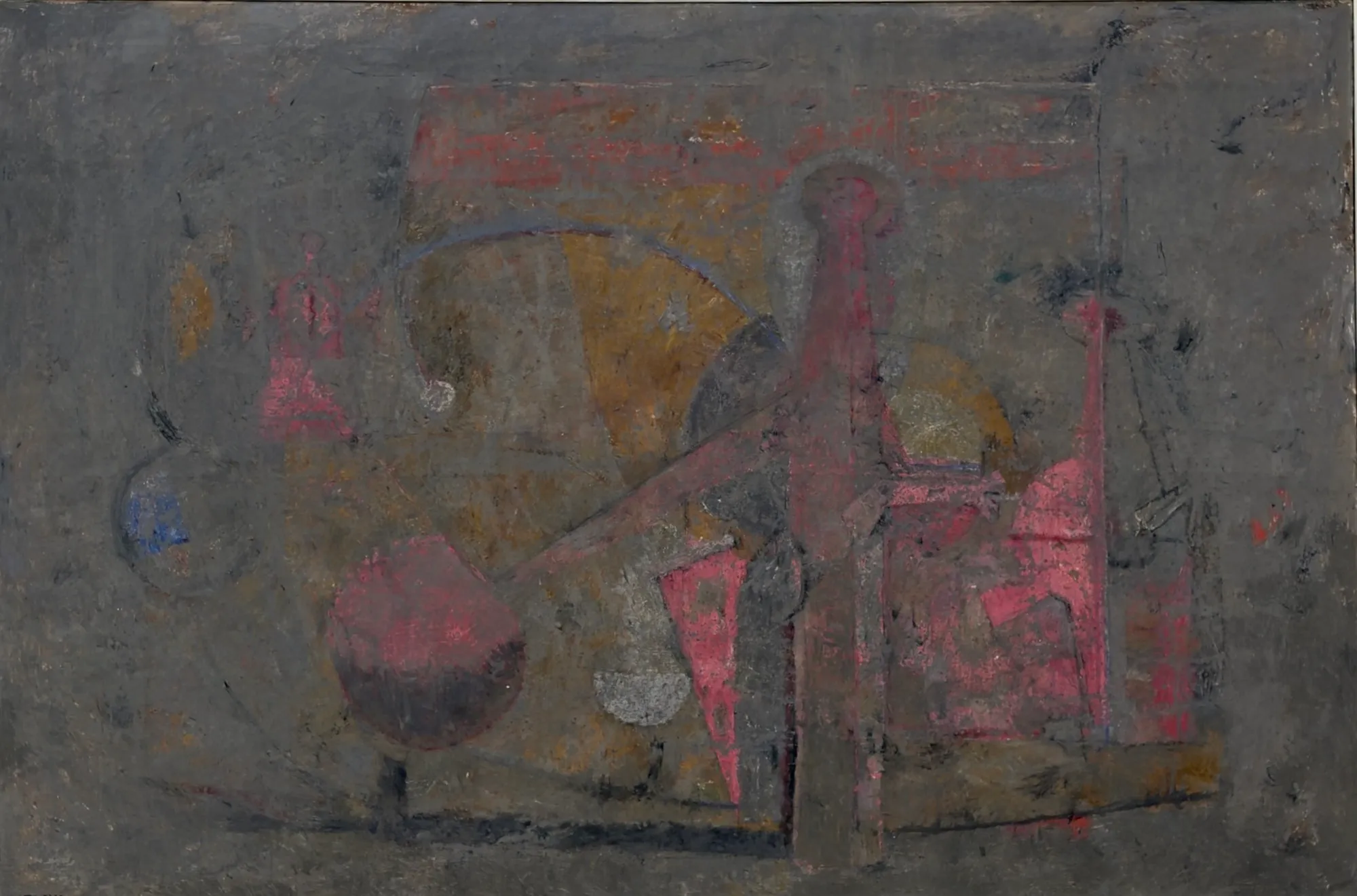
Rufino Tamayo, Juego de niños, 1960. Oil on canvas. Private collection, courtesy Galería Lourdes Sosa.
That gesture got me thinking. There is something strange about making an image and then hiding part of it. About building a form and refusing to resolve it completely. About adding color, then muting it. Scratching, layering, erasing, repeating.
The work feels intentional without feeling overexplained.
I don’t think the interesting claim is that AI could never produce something visually similar. It obviously can. AI can already reproduce texture, distortion, brushwork, collage, irregularity, and almost any visual language we can describe. It will keep getting better.
Eventually, “looking human” may become one of the easiest aesthetics to manufacture.
What interested me was something underneath the image.
Why did one of us need to make it?
Our intelligence did not evolve on its own. It evolved inside a body, inside an animal that gets hungry, forms attachments, and depends completely on others early in life. And that dependence does not really end.
There is almost no meaningful version of our lives that we live alone. We continue depending on one another for food, knowledge, safety, language, identity, care, work, and belonging. Even the fantasy of total independence is made possible by systems built and maintained by other people.
We search for belonging. We fear rejection. We compete for status. We play, desire, grieve, remember people who are gone, and anticipate loss. Eventually, we become aware that we will die.
Emotion is often discussed as though it were something added to intelligence. Reason over here. Feeling over there.
But the brain systems behind emotion are older. We share them with other animals, and they come from the biological problems our ancestors had to solve simply to survive together. Attachment matters because human children depend on others for an unusually long time. Belonging matters because, for our ancestors, isolation could be fatal. Fear matters because organisms that failed to detect danger left fewer descendants.
Desire, jealousy, affection, play, grief, status, and care are all tangled into the kind of animal we became.
Intelligence evolved inside that condition. So did art.
A painting matters because something mattered to the person making it. Something was desired, remembered, feared, rejected, protected, mourned, or explored. The marks are part of that encounter. They are evidence of what it is like to experience the world from inside one of our lives.
Almost every conversation about AI eventually becomes a conversation about usefulness.
Which jobs will remain? Which skills will matter? What can we still do better? What becomes cheaper? Who becomes more productive? What should be automated?
Those are important questions. But they quietly introduce another assumption: that our value comes from our usefulness.
We already behave as though that is not true.
A newborn baby contributes nothing economically. In strictly practical terms, a baby is a drain on resources. It takes time, money, sleep, attention, and work. It places heavy demands on parents and on the community around them.
And yet parents reorganize their lives around that child. Families protect it. Communities build systems to care for it.
Its value is not earned through usefulness. It is intrinsic.
The same is true at the other end of life.
A person with advanced dementia may lose memory, language, reasoning, and independence. They may contribute very little in any practical sense and require a great deal of care.
They do not therefore become less valuable. Their value was never contingent on their productivity.
We do not choose friends by processing speed. We do not love our parents because they outperform other parents on cognitive benchmarks. Someone extraordinarily intelligent can cause great suffering. Someone of completely ordinary intelligence can become the most important person in another human being’s life.
We already behave as though intelligence is not the source of human worth. And yet intelligence has been one of the central ways we have justified our importance.
That contradiction was always there. AI is making it harder to avoid.
Price, usefulness, productivity: each is a way of asking what something is worth. None of them quite works for a person.
Maybe intelligence was never the source of our value. Maybe it was the source of our power.
It allowed us to build cities, develop mathematics, compose music, invent vaccines, split atoms, photograph galaxies, rewrite genes, and eventually build machines capable of participating in cognition itself.
That power is extraordinary. But power and value are not the same thing.
This is where another temptation appears. If intelligence is no longer uniquely human, perhaps another property takes its place.
Creativity. Consciousness. Emotion. Empathy. Embodiment. Love. Mortality.
Pick another capability and build a new border around humanity. But that repeats the same mistake. It changes the test.
If creativity becomes the reason we matter, what happens to the person who cannot create? If consciousness is the answer, how much consciousness is required? If emotional richness becomes the standard, what happens to someone whose ability to communicate emotion is profoundly limited?
A newborn does not need to demonstrate creativity to deserve care. A person does not need to pass a consciousness exam to deserve dignity.
Human value cannot depend on winning a capability contest. That includes a contest against machines.
Standing in front of those works did not give me a new definition of humanity. They gave me a more concrete way to think about the question.
We experience life from inside a body, inside relationships, inside time. Inside needs we did not choose and memories we cannot completely control. Inside the strange condition of being an animal capable of understanding that its own existence is temporary.
Art sometimes makes that condition visible. Not neatly. Sometimes through a violent field of color. Sometimes through a figure that almost disappears. Sometimes through a layer of gray paint laid over something that was already there.
There is a lot of talk right now about making things feel more human. Branding is becoming rougher. Typography more irregular. Images more tactile. Designers are reaching again for paper, grain, handwriting, collage, and visible imperfection.
That makes sense to me, as a trend. As synthetic production becomes easier, there may be a stronger appetite for evidence of human presence.
But rawness itself is not the value. AI can manufacture rawness too.
I keep thinking about Tamayo’s gray. Someone chose to put it there. Generating an image and making a work are different things. A mark matters because somebody meant something by it. A choice carries weight because something was at stake for the creature making the choice.
And even intent may not ultimately explain human worth. Maybe the mistake was thinking that human value needs to be justified by a capability at all.
Perhaps we have spent too much time asking what makes us superior, when the more difficult question is why superiority should determine value in the first place. We have spent centuries looking for another hill to stand on.
I do not have a clean answer. I’m suspicious of clean answers here.
But intelligence may no longer be available as the shortcut it once was. We are building more of it outside ourselves, and that may force a question we have postponed for a very long time.
What is a human being worth now, when intelligence is no longer uniquely human?
Sources
News
- The White House. “Inaugurating The Era of Super Intelligence,” Executive Order 14434. September 29, 2026.
- The White House. “Fact Sheet: President Donald J. Trump Inaugurates The Era of Super Intelligence.” September 29, 2026.
- Nextgov/FCW. “White House unveils ‘super intelligence’ executive order and industry accord.” September 29, 2026.
- Reuters, published in The Nightly. “Donald Trump set to host executives of AI firms at White House to address potential risks of the technology.” September 30, 2026.
- Reuters, published in The Star. “OpenAI takes on Meta with dots agent in autonomous AI push.” September 30, 2026.
- OpenAI. “Introducing dots.” September 29, 2026.
- OpenAI. API changelog, entries for September 10 and September 29, 2026.
- OpenAI. DevDay 2026 recap.
- OpenAI. “Introducing the Agents API.” September 10, 2026.
Science
- Homo sapiens: Linnaeus, C. (1758). Systema Naturae, 10th edition.
- Tool use in animals: Goodall, J. (1964). Tool-using and aimed throwing in a community of free-living chimpanzees. Nature 201. Hunt, G. R. (1996). Manufacture and use of hook-tools by New Caledonian crows. Nature 379.
- Memory: Clayton, N. S., and Dickinson, A. (1998). Episodic-like memory during cache recovery by scrub jays. Nature 395.
- Planning: Raby, C. R., et al. (2007). Planning for the future by western scrub-jays. Nature 445.
- Cooperation: Wilkinson, G. S. (1984). Reciprocal food sharing in the vampire bat. Nature 308.
- Communication: Seyfarth, R. M., Cheney, D. L., and Marler, P. (1980). Monkey responses to three different alarm calls. Science 210.
- Culture: Whiten, A., et al. (1999). Cultures in chimpanzees. Nature 399.
- Intelligence and the body: Varela, F. J., Thompson, E., and Rosch, E. (1991). The Embodied Mind. MIT Press. Barsalou, L. W. (2008). Grounded cognition. Annual Review of Psychology 59.
- Emotion: Panksepp, J. (1998). Affective Neuroscience. Oxford University Press. Anderson, D. J., and Adolphs, R. (2014). A framework for studying emotions across species. Cell 157. LeDoux, J. (2012). Rethinking the emotional brain. Neuron 73.
- Attachment and dependency: Bowlby, J. (1969). Attachment and Loss, Vol. 1: Attachment. Hogarth Press. Hrdy, S. B. (2009). Mothers and Others. Harvard University Press. Dunsworth, H. M., et al. (2012). Metabolic hypothesis for human altriciality. PNAS 109.
- Belonging and isolation: Baumeister, R. F., and Leary, M. R. (1995). The need to belong. Psychological Bulletin 117. Holt-Lunstad, J., Smith, T. B., and Layton, J. B. (2010). Social relationships and mortality risk. PLoS Medicine 7. Cacioppo, J. T., Cacioppo, S., and Boomsma, D. I. (2014). Evolutionary mechanisms for loneliness. Cognition and Emotion 28.
- Fear: Öhman, A., and Mineka, S. (2001). Fears, phobias, and preparedness. Psychological Review 108.
Art
- Museo Tamayo. Tamayo, Nieto, Toledo: The Paris Years. August 20, 2026 to February 15, 2027.
- La Jornada. “Muestra reúne más de 100 obras de los oaxaqueños Nieto, Tamayo y Toledo.” September 1, 2026.